

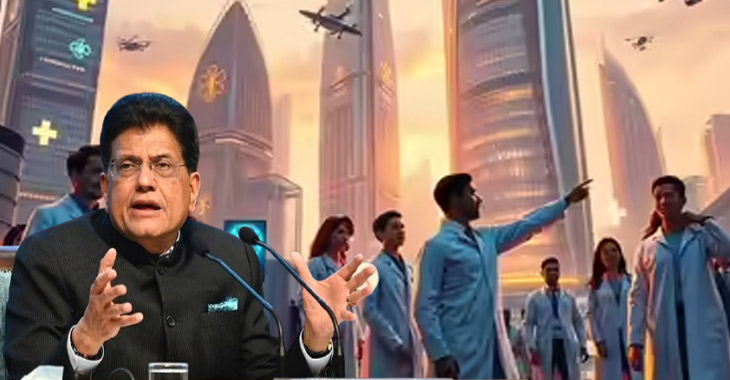
India’s free trade agreements (FTAs) are creating new prospects for the pharmaceutical, healthcare, and medical technology industries, while allowing the nation to consolidate its place in international trade, according to a statement made by Commerce and Industry Minister Piyush Goyal on Monday.
Speaking at the post-Budget Webinar 2026, which focused on “Sabka Saath Sabka Vikas: Fulfilling Aspirations of People,” Goyal said that India has signed a total of nine Free Trade Agreements in the previous three to three and a half years, with five of those agreements being finalized in the last 12 months, under the leadership of Prime Minister Narendra Modi.
Consequently, India may now access about two-thirds of the world’s trade.
He said that these agreements give India preferential access, with reduced tariffs and increased market opportunities, thus creating new avenues for trade development.
Free Trade Agreements, according to Goyal, are connected to farmers, fishermen, MSMEs, small businesses, traders, and major industries.
Additionally, he said that these agreements provide new global possibilities for those employed in innovation and emerging technologies, as well as benefit industries like pharmaceuticals and the med-tech industry, which produces medical devices.
India is well known for its prominent role in the pharmaceutical business, and he emphasized this by referring to it as the Pharmacy of the World.
According to him, Free Trade Agreements will only be effective if companies and organizations make use of them. Trade and commerce must ultimately be driven by industry, even if the government may open doors and provide opportunities.
In order for India to have a comprehensive healthcare ecosystem that integrates production, innovation, businesses, and hospitals, Goyal stated. The nation will be able to maximize the opportunities presented by free trade agreements thanks to such an integrated environment.
He continued by saying that MSMEs will have a key role in this process, notably in improving quality. He said that boosting testing infrastructure and quality standards will help ensure that items exported from India promote the Brand India brand and highlight the nation’s capabilities worldwide.
He claimed that India has existing agreements or ongoing discussions with significant economies and areas, such as the United States, the European Union, the United Kingdom, Australia, and New Zealand, as well as with the four nations that make up the European Free Trade Association: Switzerland, Norway, Liechtenstein, and Iceland.
Additionally, agreements have been made with Oman and the United Arab Emirates in the Gulf region, and all six members of the Gulf Cooperation Council have shown an interest in signing agreements with India.
Additionally, he stated that negotiations with Canada are moving forward quickly, as are discussions with the Eurasian Economic Union and Latin American Mercosur nations.
The growing international interest in strengthening trade links with India is, according to Goyal, a reflection of the understanding of India’s economic promise. In the next two to two and a half decades, the Indian economy, which is now worth about $4 trillion, has the potential to expand to about $30 trillion, according to him, offering an unprecedented chance for global economic integration.
The minister stressed the necessity of forging a stronger connection between the healthcare industry and exports. He argued that India should concentrate on educating qualified workers, such as nurses and caregivers, for whom there is a high demand in both India and other countries.
India may create a workforce that promotes exports, boosts remittances, and makes Indian goods and services available worldwide by improving skill development.


Leave a Reply